
Money on a phone: exchange rates, fees and the bank approval in between
How much each featured agent adds through its exchange rate, every piece of a haul's cost, and how to keep card payments from going wrong on a phone.
Exchange rates, as each agent converts them
Listings are priced in yuan. When an agent shows you a price in dollars, euros or pounds, it uses its own exchange rate, and that rate is usually less generous than the mid-market rate you see in a currency app. The gap is a margin, and it applies to everything you pay through the agent: the item, domestic delivery and later the shipping.
Read the figures as a snapshot. Rates move daily, and agents adjust their own rates on their own schedule. LoongBuy's margin was lower than most in these figures but higher than CSSBuy's; LitBuy's was the largest. On a phone, the easiest check is to open the same item on two agents and compare the converted prices with the yuan price both of them show.
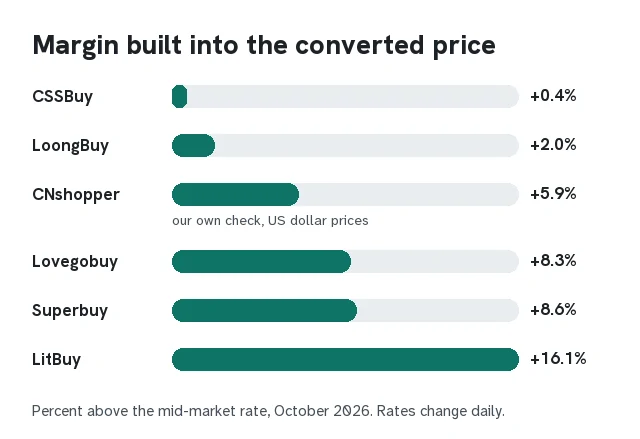
| Agent | Source of the figure | Margin over the mid-market rate |
|---|---|---|
| LoongBuy | Independently measured, October 2026 | +2.0% |
| CSSBuy | Independently measured, October 2026 | +0.4% |
| Superbuy | Independently measured, October 2026 | +8.6% |
| Lovegobuy | Independently measured, October 2026 | +8.3% |
| LitBuy | Independently measured, October 2026 | +16.1% |
| CNshopper | Our own check, 17 October 2026 | +5.9% on US dollar prices |
What a haul costs, piece by piece
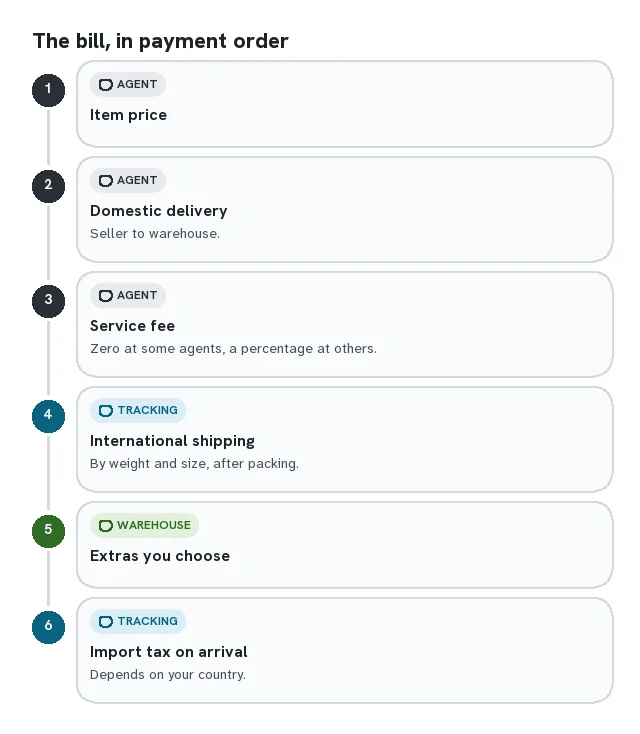
Here is the full cost breakdown of a typical haul, in the order you pay it. First the item price, set by the seller. Then domestic delivery from the seller to the agent's warehouse, also set by the seller and often a few yuan. Then the agent's service fee, if it charges one: CSSBuy lists 6 percent of item price plus domestic delivery for ordinary members, with lower rates at higher member levels; LoongBuy, Superbuy, Lovegobuy and LitBuy publish no purchasing fee on mainstream marketplaces; CNshopper's own pages contradict each other on this point.
Later comes international shipping, priced by weight and size once the parcel is packed, plus any paid extras, for example additional photos or stronger packaging. Superbuy and Lovegobuy both mention a customs declaration charge of generally 8 yuan per parcel. Finally, depending on your country, there may be import tax or duty on arrival. Amounts collected through the agent use the conversion shown there; a destination authority, courier or payment provider may collect other charges separately.
Agents describe their fees on these pages: CSSBuy service fee article, Superbuy fee composition page, Lovegobuy fee article and CNshopper two-step payment guide.
When the bank asks for a second approval
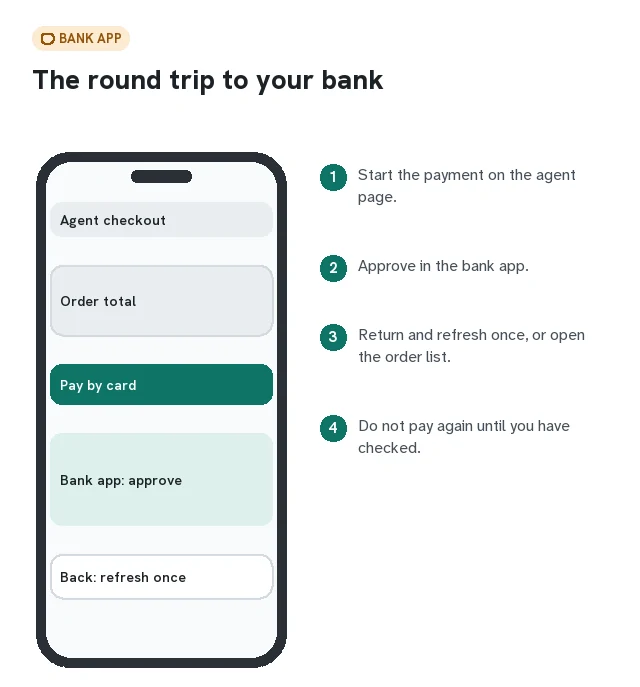
Card payments to agents often trigger an extra check, known as 3-D Secure, where your bank asks you to approve the payment in its own app or with a code. On a phone this means leaving the agent page for a moment. That is where payments go wrong.
- Before paying, make sure your banking app is installed and that you can sign in to it.
- Start the payment on the agent page and wait for the bank prompt.
- Switch to the banking app, approve, and switch back.
- If the agent page has not moved on, refresh it once or open your order list. Do not start a new payment straight away; the first one may already have gone through.
Some agents also offer wallets such as Apple Pay or Google Pay, which approve inside the phone itself; LitBuy and CNshopper show both among their payment options. LoongBuy and the others list several methods; the checkout page shows which apply to your country. Check the order list before paying twice.
Balances, refunds and the money you leave behind
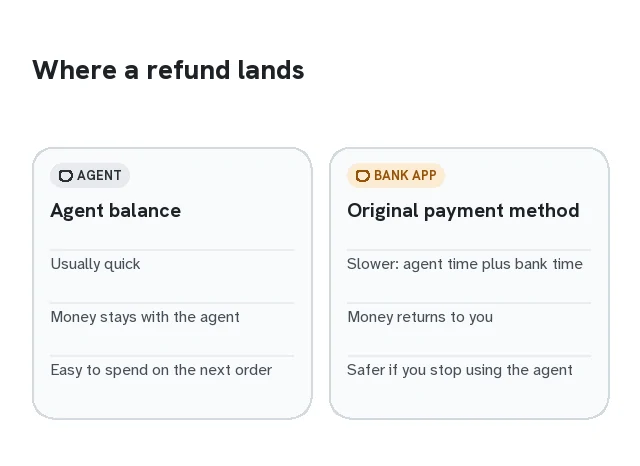
Some agents let you pay from a prepaid balance: you top up once and pay items and shipping from it. That is convenient on a phone, where each payment can mean another bank approval, but it also means money sits with the agent. Keep the balance close to what your next order needs.
Refunds come back in two ways: to the agent balance, or through a withdrawal or refund to a payment method. Processing stages and timing depend on the provider. LitBuy states that refunds go only to the original method, after its own processing time plus the time your bank or payment provider needs. Read how your agent handles refunds before an item is cancelled, not after.
Three separate records when a payment is unresolved
First, your payment provider shows an authorization or settled charge. Second, the agent may show a top-up or an order payment. Third, the order records whether procurement happened. Do not assume that one automatically proves the next. Match time, currency, amount and reference through the provider’s own secure support channel.
For a refund, record approval, balance credit, withdrawal request and receipt separately. Ask which step is incomplete and keep the response. A second charge or repeated withdrawal attempt can make reconciliation harder; wait for an explanation of the existing reference rather than creating another transaction to test it.