
Weighing shopping agents, fees first and phone included
Six measures for comparing agents side by side, with no overall winner, plus a short checklist to run before you add money to any agent account.
Six measures, with fees at the top
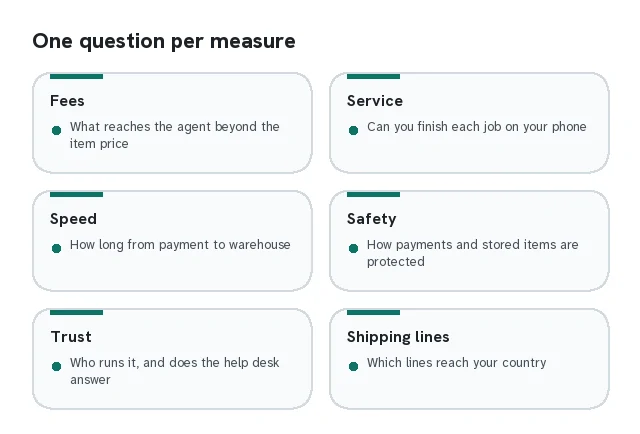
Here is how to compare agents without inventing a winner. Use six measures: fees, service, speed, safety, trust and shipping lines. Fees come first because they are the part you can read before you pay anything, and because small differences add up across several hauls. The other five decide whether the fees were worth it.
Read each measure from the agent's own pages, with a date next to anything you note down. Agent fees, storage periods and payment options change, and a comparison that is three months old can mislead. The pages linked from Agent apps were all read on 18 October 2026.
Fees, read as three separate charges
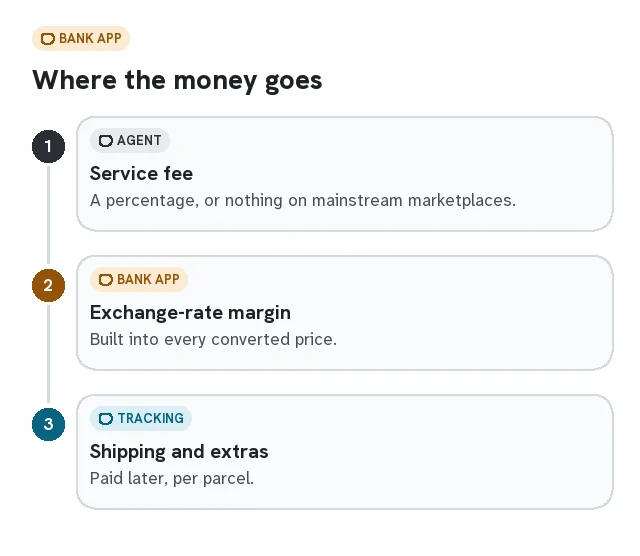
An agent's cost reaches you in three places. The first is the service fee, a percentage on the item price or nothing at all. CSSBuy charges ordinary members 6 percent of the item price plus domestic delivery, with lower rates for higher member levels; LoongBuy, Superbuy, LitBuy and Lovegobuy publish no purchasing fee on mainstream marketplaces.
The second is the exchange rate. When the agent converts yuan into your currency, it builds in a margin. That margin can be larger than a service fee: in measurements from October 2026, the six featured agents ranged from well under 1 percent to about 16 percent above the mid-market rate. The third is shipping, paid later, plus small extras such as a customs declaration charge per parcel that some agents list.
Money lists each featured agent's figures with dates. The point here is the order: read all three before deciding an agent is cheap.
Service, counted as what the phone lets you finish
Service usually means how quickly the help desk replies and how carefully the warehouse works. Both matter, and both are hard to measure from outside. One part of service you can measure is whether the agent's phone site or app lets you finish each job.
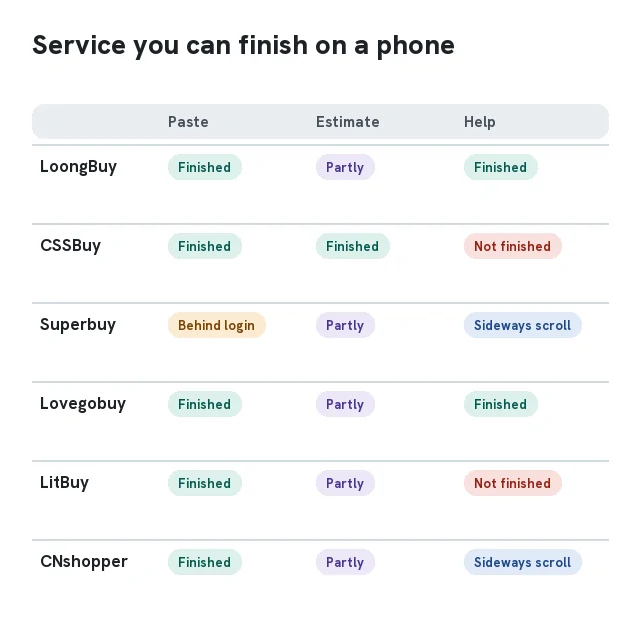
In our check on 18 October 2026, signed out, five of the six featured agents turned a pasted link into an item page; Superbuy sent us to sign in first. Only CSSBuy's cost page returned shipping prices on the phone site, while LoongBuy, Lovegobuy, LitBuy and CNshopper showed forms that fitted the screen but did not give us a result, and Superbuy's opened in Chinese. Help centres split the same way: LoongBuy and Lovegobuy were readable, Superbuy and CNshopper needed zooming or sideways scrolling, and CSSBuy and LitBuy did not show us one at all.
These observations concern signed-out website access on one day. They do not establish app functionality, support quality or the experience of a signed-in customer.
Speed, safety and trust
Speed is mostly the time between your payment and the item reaching the warehouse, which depends on the agent's buyers and on the seller. Agents publish purchasing hours; the seller’s stated dispatch window and actual status must be checked separately. Expect several days, longer around Chinese holidays.
Safety covers how your money and stored items are protected: payment through recognised card and wallet providers, clear storage periods, and a written policy for items lost or damaged in the warehouse. Storage terms differ: CSSBuy, Superbuy, LitBuy and CNshopper state 90 days for items, Lovegobuy 60, and figures measured in October 2026 put LoongBuy at 90.
Trust is the hardest. Some agents take payment and never buy the item, or stop answering when a refund is due; this is what people mean when they say an agent ate their order. Look for a named operating company, published policies with dates, and a help desk that answers a simple question before you have paid anything.
Shipping lines to your country
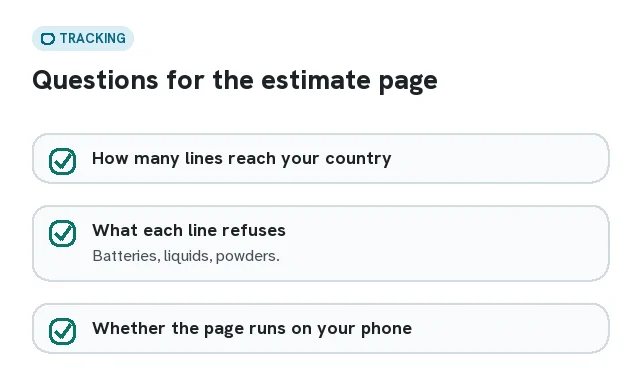
Route coverage is the last measure and the most local one. An agent may offer dozens of lines in total and only one or two to your country, or none that accept a parcel with a battery or a liquid in it. Check the estimate page for your own country and a realistic weight before you sign up.
On a phone this is where pages strain. CSSBuy's cost page gave us results as stacked cards that were easy to read; other estimate pages fitted the screen but needed an account or did not return a result for us. If an estimate will not run on your phone, try the same page on a computer before ruling the agent out.
A checklist before you top up a balance
Run this list against any agent before you add money to its wallet. It covers the four things people most often wish they had checked.
- Fee transparency. Can you find the service fee and see the converted price of an item before signing up?
- Storage terms. How many free days, counted from when, and what happens after?
- Compensation and disputes. Is there a written policy for loss, damage and items that do not match, with a deadline for claims?
- The operator. Does the site name the company that runs it, and is there a working contact other than a chat bubble?
If an answer is missing, ask the help desk. How it replies is part of the answer.