
What a shopping agent does, and when you need it
An agent is a buyer inside China that acts on the links you send. This page covers what that means, when it is worth it and where its job ends.
A buyer in China who acts on your link
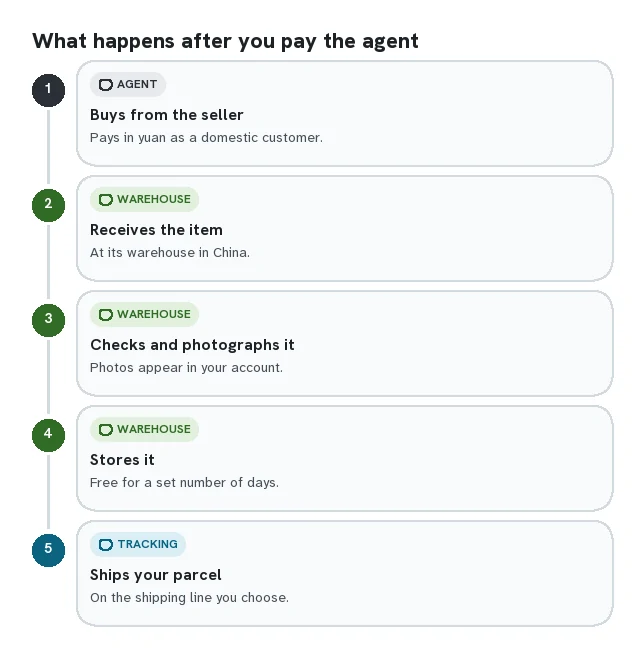
A Chinese shopping agent is a company that acts on your behalf on Chinese marketplaces. You send it a product link; it pays the seller in yuan, has the item delivered to its warehouse in China, checks it, photographs it, stores it with anything else you buy, and finally ships everything to you in one parcel. You pay the agent rather than the seller, usually through a balance in your account.
The reason the job exists is simple. Most sellers on Taobao, Tmall, Weidian and 1688 sell only inside China. Their checkout expects a Chinese phone number and a Chinese payment method, and they do not post abroad. The agent is a domestic customer with a warehouse address, which is all the seller needs to see.
Everything the agent does for you happens in its app or on its website, and that is why this guide reads agents through the phone: the agent's screens are where you place the order, approve payments, look at photos and build the parcel.
Reasons to buy through an agent, and times you do not need one
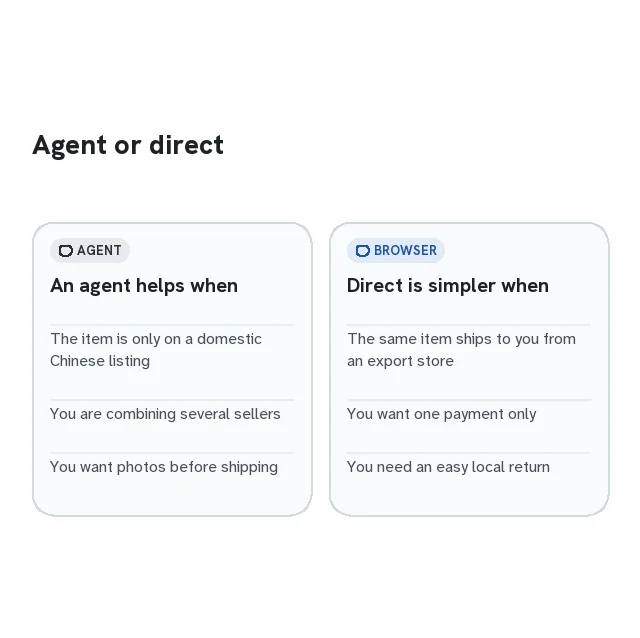
Why use an agent at all? Because the item you want is listed only on a domestic marketplace, and the seller will not take a foreign card or post abroad. An agent also lets you combine several sellers into one parcel, which may reduce repeated charges but can also increase volumetric weight or restrict eligible routes, and it shows you the item in photos before it leaves China.
There are also times when you do not need an agent. If the same item is sold on a store that already ships to your country, buying there can be simpler: one payment, a familiar returns process, and no second bill for shipping. Agents make sense when the item exists only on a Chinese domestic listing, or when you are buying several things from different Chinese sellers at once.
On a phone, the agent route has one extra cost worth knowing about: more screens. You will move between a social app, a browser, the agent and a bank app. The route card exists to make those moves predictable.
What an agent cannot do for you
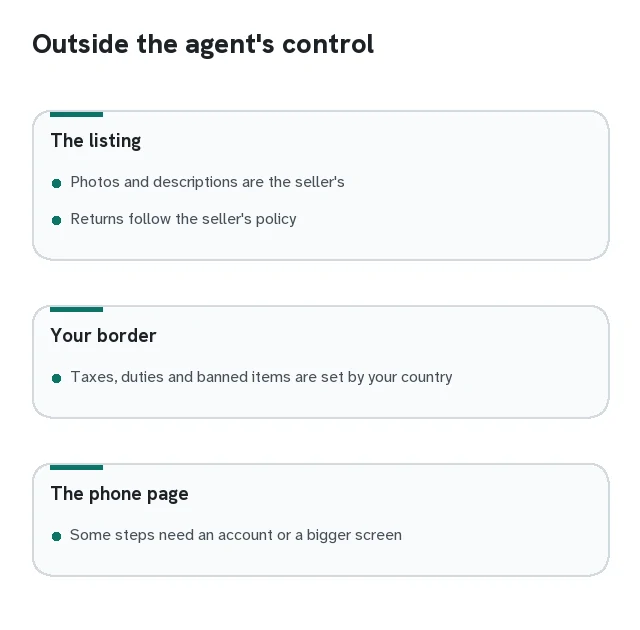
An agent buys what the listing describes; it does not make the listing true. If the seller's photos flatter the item, warehouse photos may reveal a visible difference if the relevant detail is shown, but the agent is not the seller and cannot change what was made. Returns to a Chinese seller depend on that seller's own policy, and once a parcel has left China a return is rarely practical.
An agent also cannot change the rules at your border. Import taxes, duties and banned items are set by your country, and the agent's shipping line simply carries the parcel to where those rules apply. Each featured agent keeps a public list of items it will not buy or ship; goods that copy a brand's logo or name can be refused, and customs can seize them.
Finally, an agent cannot make a phone site do what it was not built to do. In our check several agents sent cart and warehouse pages to a sign-in screen, which is expected, and two had help pages that were hard to read on a phone. Plan for that rather than discovering it halfway through a payment.
Office hours on the far side of your phone
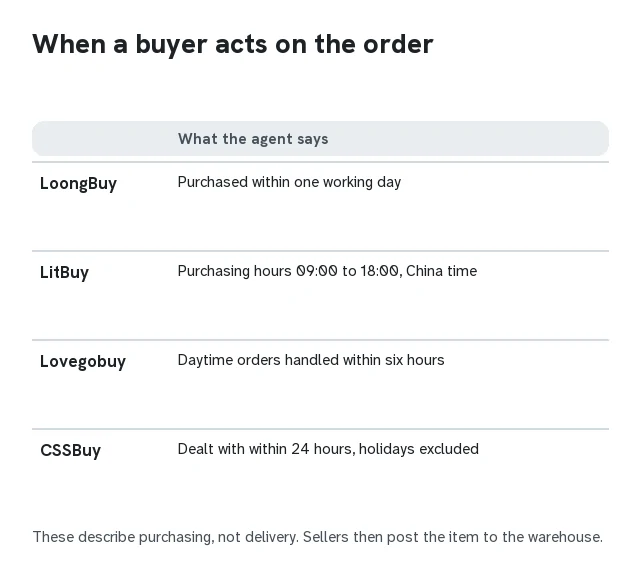
Your phone is awake at any hour; the agent's buyers are not. Purchasing happens during working hours in China, which is easy to forget when you pay late at night in Europe or the Americas. LoongBuy's item page told us an order would be purchased within one working day. LitBuy lists purchasing hours of 09:00 to 18:00 China time. Lovegobuy promises to process an order placed during the Beijing working day inside six hours, and one placed at night by the following afternoon. CSSBuy says orders are dealt with within 24 hours, excluding holidays.
None of these are delivery promises; they describe when a buyer will act on your order. The seller then needs its own time to post the item to the warehouse, often several days. Chinese public holidays pause much of this, so a haul started just before one can sit still for a week.
If you need a reply from the agent, the same hours apply to most help desks. Check the published support hours and the ticket history; neither your timezone nor a notification guarantees a reply time.